The jiu jitsu belt system is one of the most recognized symbols in all of martial arts, and one of the most misunderstood. Most people assume belts have been around for centuries, handed down from ancient warriors. They have not. The colored belt is a little over a hundred years old, it was invented by a schoolteacher, and it was designed to solve a very practical problem. Understanding where the belt came from makes it a lot clearer what it actually measures, and why the wait between promotions is the point rather than the obstacle.
The Jiu Jitsu Belt System Is Younger Than You Think
Before the 1880s, martial arts in Japan had no belts at all. Students trained under a teacher until that teacher decided they were ready, and proficiency was recorded with scrolls, certificates, and licenses. There was nothing you could look at across a training hall to tell you who had been there ten years and who had walked in that morning.
That changed with Jigoro Kano, the founder of judo. Kano was a professional educator, and he thought like one. He had seen ranking used in other Japanese pursuits, including the strategy game Go, and he wanted a visible way to separate his advanced students from his beginners. Around 1883 he began awarding formal rank, and by 1886 his senior students were wearing black belts to mark it.
The original system had exactly two colors. White for students, black for those who had proven they understood the fundamentals well enough to teach them. That was it.
How the Colors Arrived
Two belts turned out to be too blunt an instrument. A student on day one and a student four years in both wore white, which told nobody anything and gave the newer student no sense of progress. Kano began adding intermediate ranks between the two ends.
The full color spectrum most academies use today came later and came from Europe. Mikinosuke Kawaishi, a judo instructor teaching in Paris, is widely credited with introducing colored belts in 1935, specifically to give European students visible milestones and keep them training through the long stretches where improvement is hard to feel. Records from a London judo club suggest colored belts were in use there as early as 1926.
That origin is worth sitting with. The colors were never about status. They were invented as a retention tool, a way of telling a student who could not yet see their own progress that the progress was real.
The Journey to Brazil
In 1914 one of Kano’s students, Mitsuyo Maeda, arrived in Brazil. What he taught there became the foundation of Brazilian jiu jitsu, and the ranking concept traveled with him even though the colors had not been invented yet. Brazilian jiu jitsu eventually developed its own belt structure, related to judo but distinct from it, with its own colors, its own timelines, and its own culture around promotion.
That structure became the jiu jitsu belt system that almost every academy in the world uses today.
The Adult Belt Ranks
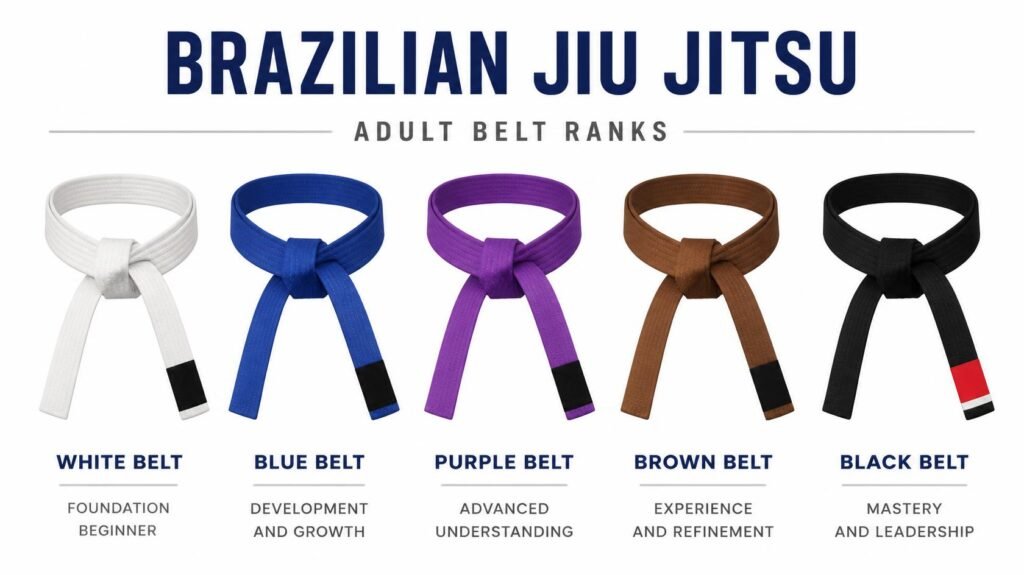
The adult side of the jiu jitsu belt system is short, which is exactly what makes it demanding. Five belts, and years between most of them.
- White belt. Everybody starts here. The job is survival, escapes, learning to be comfortable under pressure and to breathe when you would rather panic.
- Blue belt. The first real proof of persistence. A blue belt has a functional game, knows the major positions, and can defend themselves in live training.
- Purple belt. The middle of the road, and often where a practitioner’s personal style shows up. Purple belts are dangerous, and they usually start teaching.
- Brown belt. Refinement. Fewer new techniques, far better execution of the ones they already have, and a much deeper understanding of timing.
- Black belt. Not the finish line, and every black belt will tell you so. Across most schools it takes roughly eight to twelve years of consistent training, and that timeline has held steady for decades.
There is no shortcut in that list. There is no version of it that can be bought, tested into over a weekend, or accelerated by paying more.
The Kids Jiu Jitsu Belt System Is Built Differently, On Purpose
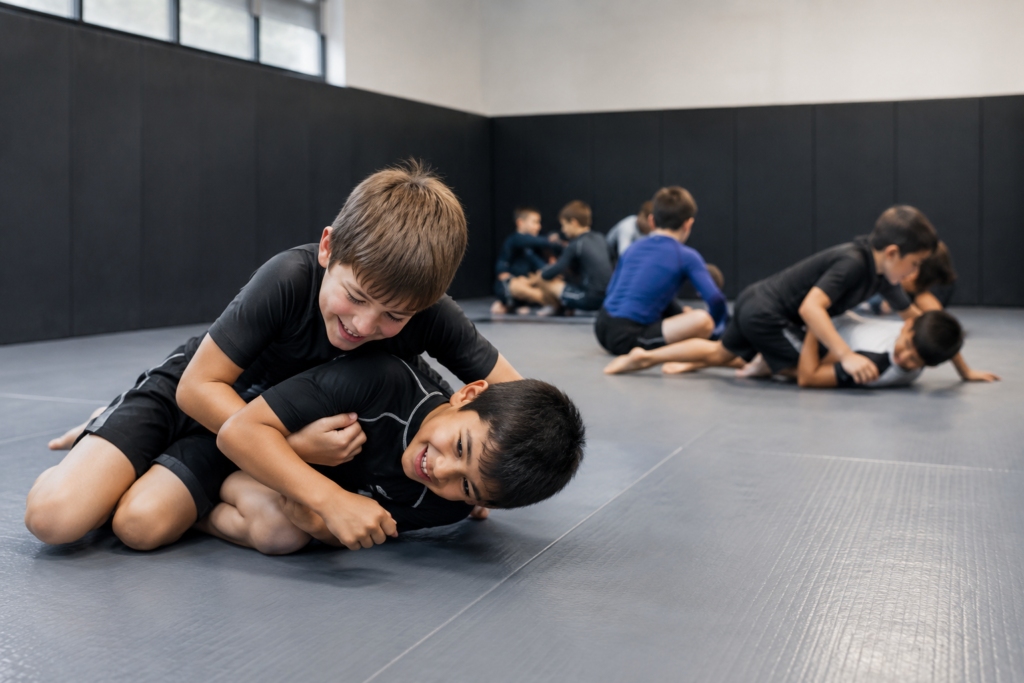
Children do not develop on an adult timeline, and a system with five belts across a decade would fail them. So the kids jiu jitsu belt system is deliberately built with more steps and shorter gaps.
Under the International Brazilian Jiu-Jitsu Federation standard, kids from roughly age four to fifteen progress through white, grey, yellow, orange, and green. Each color except white is divided into three levels, a color and white belt, a solid color belt, and a color and black belt. That creates thirteen distinct youth ranks, with stripes awarded along the way inside each one.
Each color also carries a minimum age, so a child cannot skip developmental stages no matter how athletic they are. Grey belts generally start at four and up, yellow around seven and up, orange around ten and up, and green around thirteen and up. At sixteen a young grappler moves into the adult system, usually entering at blue belt.
The reason for all those extra steps is simple. A ten year old needs to see evidence that showing up is working. Thirteen ranks means thirteen moments where a kid gets told, in front of the people they train with, that their effort was noticed. That is not a participation trophy. Every one of those ranks still has to be earned on the mat.
How No Gi Academies Handle Rank
Traditional jiu jitsu is trained in a gi, the heavy cotton uniform, and the belt is worn around the waist every class. Many modern academies train exclusively no gi, in shorts and a rashguard, which raises an obvious question. Where does the belt go?
In no gi programs the belt is typically awarded ceremonially. The student receives a real belt to take home as a record of the achievement, and rank on the mat is identified by the color of the rashguard instead. The jiu jitsu belt system underneath is identical, same five colors and same meaning, only the delivery changes.
Some no gi systems also drop stripes and degrees entirely and promote belt to belt. There is no partial credit and no intermediate marker, which means the standard for each promotion has to be met in full before it happens. Promotion sits with the head coach, based on skill, mat time, and how a student performs against live resistance, and higher ranks are typically signed off by a black belt.
Different presentation. Identical principle. The rank has to be earned in front of witnesses, against people who are trying to stop you.
What a Belt Actually Measures
Here is the part that matters most, especially for parents.
A belt is not a certificate of talent. It is a record of accumulated evidence. It says a person kept showing up on the days it was hard, absorbed correction without quitting, tested what they learned against someone actively resisting, and got better in a way that was visible to people who know what they are looking at.
Nothing in that process is given. Every single piece of it is earned.
That is why jiu jitsu translates so well outside the training room. A kid who learns that progress is slow, that failure is information rather than humiliation, and that consistency beats natural ability will carry that into the classroom and through life. The belt is just the receipt.
You can read more about the standardized youth and adult ranking requirements directly from the International Brazilian Jiu-Jitsu Federation.
Training in Georgetown, Texas
Families across Georgetown, Round Rock, Hutto, Cedar Park, Leander, Jarrell, and Liberty Hill drive in for kids jiu jitsu classes, and most of them are not walking in with a background in martial arts. They are walking in because they want their kid to be more confident, more focused, and better prepared to handle themselves.
That is exactly what the jiu jitsu belt system was designed to support. Small, honest, earned steps forward. Whether you are looking at jiu jitsu classes in Georgetown TX for yourself or for your child, the path is the same one Kano sketched out over a century ago.
Frequently Asked Questions
Who invented the martial arts belt system?
Jigoro Kano, the founder of judo, created the first martial arts belt ranking system in Japan in the 1880s. His original system used only white belts for students and black belts for advanced practitioners. Colored belts were added later, most notably by judo instructor Mikinosuke Kawaishi in Paris in 1935.
How long does it take to earn a black belt in jiu jitsu?
Most practitioners take approximately eight to twelve years of consistent training to earn a black belt in jiu jitsu. The exact timeline depends on training frequency, competition experience, and the head coach’s assessment. There is no fixed test date and no way to accelerate it with money.
What are the kids jiu jitsu belt colors?
The kids jiu jitsu belt colors are white, grey, yellow, orange, and green. Each color except white has three levels, a color and white belt, a solid color belt, and a color and black belt, creating thirteen total youth ranks for children ages four through fifteen.
At what age do kids switch to adult jiu jitsu belts?
Children transition to the adult jiu jitsu belt system at age sixteen. Most enter the adult system at blue belt, depending on their skill level and accumulated training time. There is no junior black belt in jiu jitsu.
Do no gi jiu jitsu schools use belts?
Yes. No gi jiu jitsu schools use the same five belt colors as traditional jiu jitsu. The belt is awarded ceremonially and taken home, while rank is displayed on the mat through the color of the student’s rashguard rather than a belt worn around the waist.
Start Your First Class in Georgetown
You do not need experience, athletic background, or any level of fitness to walk in the door. Every person on the mat started as a white belt, and every one of them was nervous the first day. What you need is a willingness to show up and learn something slowly.
Nothing here is given. Everything is earned. That is what makes it worth having.
Reach out to schedule a first class and see what the process looks like from the inside.