Jiu jitsu leg locks carried a reputation as dirty, risky techniques in Brazilian Jiu-Jitsu for decades. Old-school instructors warned against them. Academies banned them in sparring. Competition rule sets restricted them to upper belts only if they allowed them at all. The conventional wisdom was simple: leg locks were dangerous, unpredictable, and beneath the dignity of a serious BJJ practitioner.
Then the Danaher Death Squad happened When Gordon Ryan, Garry Tonon, Eddie Cummings, and their teammates started dismantling world champions with systematic heel hooks and knee bars at the highest levels of submission grappling. The BJJ world was forced to confront an uncomfortable truth: jiu jitsu leg locks were not a cheap shortcut. They were a complete system. And everyone who had ignored them for the past thirty years was suddenly and catastrophically behind.
Today, jiu jitsu leg locks are not just accepted in modern jiu jitsu, they are feared. Competitors at the highest levels build entire games around leg entanglements. Even casual practitioners now understand that ignoring the lower body leaves them vulnerable. Understanding them is no longer optional for any serious grappler, whether you train at a world-class academy or a no-gi gym in Georgetown TX.
What Are Leg Locks?
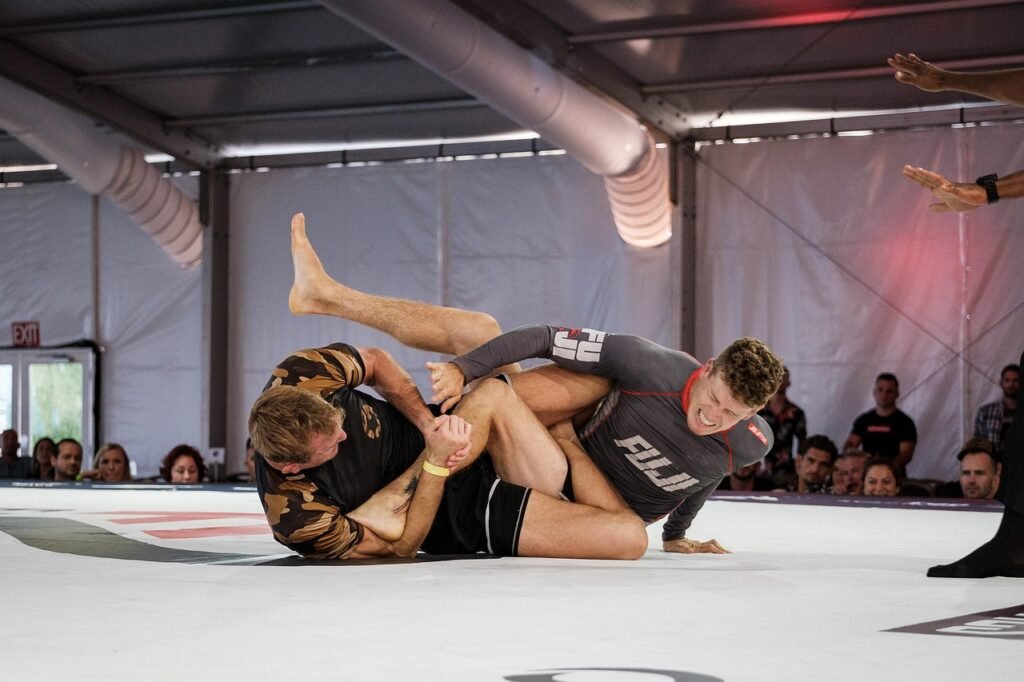
A jiu jitsu leg lock is a joint lock directed at the joints of the leg, including the ankle, knee, or hip joint. When the lock targets the foot it may be called a foot lock; when it targets the hip it is a hip lock. Leg locks are featured in Sambo, Brazilian Jiu-Jitsu, catch wrestling, mixed martial arts, shoot wrestling, and submission wrestling, but they are banned in judo. The technique is reported to be over 2,500 years old, with evidence of its use in pankration during the original Olympic Games.
Jiu jitsu leg locks attack ligaments, tendons, and the structural integrity of the joint. They can end a match almost instantly because the body has limited natural resistance to the torque or hyperextension applied to the lower limbs. Unlike chokes that render an opponent unconscious. Leg lock submissions can attack multiple joints simultaneously and generate damage faster than the human body can process pain signals — which is what makes them so dangerous and so effective.
The joints targeted include the ankle, knee, and hip. Control positions for leg locks include the inside leg triangle and the leg knot. In training, jiu jitsu leg locks are applied slowly and under control to prevent injury. The heel hook in particular is considered comparatively dangerous because it applies rotational force to the knee, and injuries often occur before pain is felt.
The Four Primary Jiu Jitsu Leg Lock Techniques
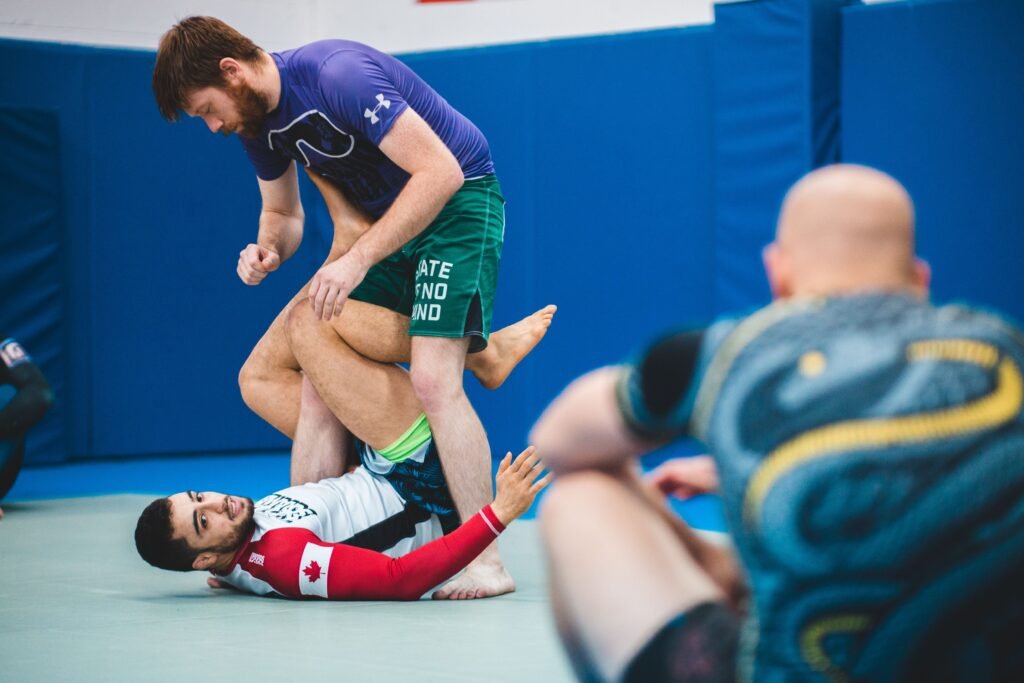
Straight Ankle Lock (Achilles Lock)
The straight ankle lock is the first leg lock most BJJ students learn. It hyperextends the talocrural joint of the ankle through plantar hyperflexion. The mechanics involve controlling the leg, placing the forearm under the Achilles tendon, locking the grip tight, and extending the hips. This technique is widely legal at all belt levels under IBJJF rules and is considered a safe entry point for beginners. It teaches the core concepts of leg control and hip extension that apply to more advanced attacks. Applied from outside sankaku or a basic single-leg control, the straight ankle lock is the gateway drug to the entire leg lock system.
Kneebar
A kneebar hyperextends the knee in a motion similar to an armbar. The attacker controls the opponent’s leg, traps the foot against their body, and extends the hips to straighten the knee beyond its normal range. Kneebars are only allowed at brown and black belt divisions under IBJJF rules. They require precise positioning to avoid injury and are less commonly used in gi competition due to the reaping rule. The kneebar is to the knee what the armbar is to the elbow — fight-ending when properly applied.
Toe Hold
The toe hold is a rotational lock that twists the foot and ankle, putting pressure on the ankle ligaments and knee. Like the kneebar, it is restricted to brown and black belt divisions in IBJJF. Toe holds can be applied from various positions but are most common in no-gi and submission-only events where the rules are less restrictive. Its effectiveness against flexible opponents can be limited, but against less mobile practitioners it is highly reliable.
Heel Hook
The heel hook is the most feared submission in modern grappling. It applies rotational torque to the knee joint by fixing the heel and twisting the lower leg. Inside heel hooks rotate the heel toward the inside of the opponent’s body, attacking the ACL, MCL, and meniscus. Outside heel hooks rotate outward, targeting the PCL and LCL. Heel hooks are completely illegal under IBJJF rules and are taught at brown belt in most gi BJJ systems. They are considered dangerous because damage to the knee often happens before the opponent feels pain. In no-gi and submission grappling, heel hooks are central to the game, and athletes dedicate significant training time to defending and attacking them.
The Historical Evolution of Leg Locks
The story of jiu jitsu leg locks in BJJ is a story of cultural bias overcoming practical evidence.
Early Brazilian Jiu-Jitsu, developed from Kodokan Judo and refined by the Gracie family, prioritized upper body control, positional dominance, and chokes. The guard, mount, and back mount defined BJJ identity, jiu jitsu leg locks existed in the system. Helio Gracie himself caught opponents with foot locks, but they were considered secondary techniques. Often associated with wrestlers or sambo practitioners who had not learned real jiu jitsu.
Sambo’s influence was significant and largely unacknowledged in traditional BJJ circles. Soviet combat sambo had developed sophisticated leg attack systems decades before the BJJ community took them seriously. Sambo practitioners who crossed over into submission grappling events regularly submitted BJJ competitors with leg locks, which created a cognitive dissonance the BJJ world resolved by dismissing sambo as not real grappling rather than updating their technical understanding.
The rise of submission grappling in the 1990s and early 2000s created competitive environments where leg locks were permitted and rewarded. Events like ADCC Submission Wrestling World Championships exposed BJJ practitioners to grapplers from wrestling, sambo, and catch wrestling backgrounds who used leg attacks freely. Fighters who faced leg lock specialists in the UFC, such as Rousimar Palhares, demonstrated that lower-body submissions can end fights even against elite competition. Palhares became known for his relentless leg attacks, proving that a well-timed heel hook or kneebar can neutralize an opponent regardless of their stand-up game.
The Danaher Death Squad changed everything. John Danaher, a BJJ black belt and philosophy academic training out of Renzo Gracie Academy in New York, developed a systematic approach to leg entanglements. His students — Gordon Ryan, Garry Tonon, Eddie Cummings, Nicky Ryan, and others — began applying this system at the highest levels of competition with devastating results. What separated the Danaher approach from previous leg lock practitioners was systematization. Rather than treating heel hooks as isolated attacks, Danaher developed positional hierarchies, entry sequences, and finishing mechanics that turned leg attacks into a complete positional game. As submission grappling grew in popularity, modern grapplers now dedicate entire game plans to positions like Ashi Garami, Straight Ashi, Outside Ashi, and the 50/50 guard. The grappling world had never seen anything like it.
Today, no serious competitor trains without a functional understanding of leg entanglements. Academies everywhere — including no-gi schools in Georgetown TX — have integrated leg lock systems as a core component of their curriculum. The era of dismissing lower body attacks is over.
Can Jiu-Jitsu Leg Locks Be Used in a Real Fight?
This is the central question for anyone training jiu jitsu in Georgetown TX or anywhere else for self-defense purposes, and the honest answer is nuanced.
Situations where leg locks may be highly effective
Against an untrained attacker on the ground, a straight ankle lock or heel hook applied from guard or half guard can end a confrontation immediately. An untrained person has no leg lock defense, no understanding of the danger, and will often struggle and compound the damage rather than tapping. Law enforcement and self-defense instructors often note that lower-body submissions can immobilize an attacker without causing the lasting damage that a choke or strike might produce. This can reduce legal liability and keep you in control.
The heel hook in particular requires almost no strength to apply. A smaller practitioner can finish a heel hook on a much larger attacker if the position is established correctly. This is not theoretical — it is the same mechanical reality that makes heel hooks so dangerous in competition.
Situations where pursuing jiu jitsu leg locks is a tactical mistake
Multiple attackers is the primary concern. Going to the ground to chase a leg lock against one attacker while a second attacker is present is potentially fatal. Ground fighting against multiple opponents is already the worst-case scenario in self-defense. Choosing a technique that puts you horizontal, requires two hands on one leg, and takes your eyes off the environment makes a bad situation catastrophically worse.
Environmental considerations matter enormously. Concrete amplifies every impact. Leg locks require fine motor skills and precise positioning, which can degrade under adrenaline and stress. Shoes, slippery surfaces, and confined spaces all affect your ability to isolate and control a leg. The leg entanglement positions that work smoothly on mats require significant adaptation on concrete.
The time dimension is different on the street. In competition, a referee will stop the match before serious injury occurs. On the street, there is no referee. A heel hook that tears an attacker’s ACL does not guarantee they stop attacking — adrenaline can override pain signals for seconds to minutes.
The risk versus reward analysis
The self-defense consensus is that jiu jitsu leg locks are valuable knowledge but should not be the primary tool in a street defense scenario. A straight ankle lock from a position you already control is a viable option. A heel hook that requires you to sacrifice top position to enter a leg knot is not advisable against an untrained attacker. The best approach is to train leg locks so that you can recognize when they are available and when it is smarter to take the back or get back to your feet.
The Biggest Misconceptions About Leg Locks
Leg locks are easy to escape
Beginners often believe that leg locks are low-percentage submissions that can be escaped by simply rolling or pulling out. In reality, modern leg-lock systems are built on layers of control. Positions like the inside leg triangle and the leg knot prevent the opponent from straightening their leg or turning away. By the time a skilled grappler locks in a heel hook, the escape windows have already closed. This misconception comes from a time when practitioners trained leg locks poorly. That is no longer true.
Leg locks don’t work in MMA
Some fighters claim that jiu jitsu leg locks are too risky in MMA because they leave the attacker open to strikes. While it is true that a failed leg lock can be punished, the success of athletes like Rousimar Palhares and Ryan Hall shows that leg locks absolutely work in MMA. Ryan Hall’s heel hook finish of BJ Penn in the UFC demonstrated that leg attacks at the highest level are not only possible but fight-ending. The reason heel hooks appear less frequently in MMA than in submission grappling is positional — MMA fighters are cautious about the ground-and-pound exposure, not because the submissions don’t work.
Leg locks only work on beginners
This misconception persists because advanced grapplers usually know how to defend common leg locks. But Gordon Ryan has finished multiple world champions with heel hooks. The Danaher Death Squad built their reputation by submitting elite grapplers, not white belts. When a brown belt catches a black belt in a leg entanglement, it is because the setup was sound, not because the defender was inexperienced.
Leg locks are too dangerous to train
It is true that heel hooks and kneebars carry a higher risk of injury than armbars or chokes. However, the danger is manageable when training partners apply the lock slowly and control the range of motion. In reputable gyms, leg locks are drilled with communication and trust. The injury risk is real, but it is not a reason to avoid the art. The alternative is remaining vulnerable to a technique that most modern grapplers now use regularly. Ignorance of heel hooks creates injury risk — practitioners who have never felt one don’t know when to tap.
Comparing Leg Locks to Other Submissions
Every submission has a place in a complete grappling system. Understanding the strengths and weaknesses of each helps you decide when to hunt a leg and when to switch to a choke or armbar.
Rear Naked Choke
The gold standard of self-defense submissions. Requires taking the back, cuts blood supply to the brain, and forces unconsciousness in 8-10 seconds with no joint damage. Superior to leg locks for self-defense because it controls the entire body. Weakness: requires taking the back, which is the highest-percentage position but not always immediately accessible.
Armbar
High percentage, well-understood, works at all levels. The armbar requires positional dominance — usually mount or guard — and is more intuitive than leg attacks. In self-defense contexts the armbar is reliable but requires the attacker to be on the ground with you. Against a standing opponent, arm attacks are limited.
Kimura
Extremely versatile — applicable from guard, side control, half guard, and even standing. The kimura grip is a powerful control tool beyond just the submission. For self-defense the kimura is arguably more practical than leg locks because it can be applied with less ground commitment and is slower to cause irreversible joint damage.
Wrestling Takedowns
Not submissions, but the foundation everything else is built on. You cannot apply a leg lock or any other ground technique if you cannot get the fight to the ground on your terms. Takedown ability is the prerequisite. Georgetown TX practitioners who ignore wrestling limit every other aspect of their game.
Leg locks, by contrast, attack the opponent’s base. When you threaten a heel hook, the opponent must change their footwork and weight distribution. This shifts their movement, making it harder for them to pass guard or counter your takedowns. The psychology of leg attacks forces the opponent to worry about their lower body, which opens up opportunities for chokes and sweeps elsewhere.
Psychology of Leg Attacks: How Leg Locks Change the Game
Leg locks do more than cause physical damage. They alter the way an opponent moves and makes decisions. John Danaher’s insight was that leg attacks change an opponent’s movement and decision-making from the first moment they are credibly threatened.
A practitioner who cannot threaten leg locks can be passed freely. Guards are jumped over without consequence. Half guard transitions are made without fear. But once your opponent knows you have a functional leg lock system, every pass attempt, every scramble, and every takedown attempt carries lower body risk. They cannot step forward without considering where their heel is. They cannot free a trapped leg without considering the rotation.
In competitive no-gi, leg lock positions such as Ashi Garami and 50/50 guard have become central to the meta. Athletes who ignore leg locks are consistently beaten by those who integrate them. This psychological edge is a legitimate tactical advantage that practitioners training no-gi jiu jitsu in Georgetown TX are particularly positioned to understand and exploit.
Where Leg Locks Fit in a Complete Grappling System
Leg locks are powerful tools. They are not magic techniques.
A practitioner who only trains jiu jitsu leg locks will be taken down by a wrestler, passed by a judo player, and choked by anyone with functional guard passing. Leg attacks require a complete game to set up — takedowns to get to the ground, guard retention to survive on bottom, passing to threaten from top, and back takes to create the positional pressure that opens leg entanglement entries.
For Georgetown TX grapplers training for competition, integrating a systematic leg lock game is not optional at the intermediate and advanced levels. The competitive landscape has shifted permanently. Knowing how to defend leg attacks is table stakes. Knowing how to attack with them is a competitive necessity.
For Georgetown TX grapplers training for self-defense, the straight ankle lock and inside heel hook are the most practical applications — they require less positional setup than kneebars or toe holds and finish more reliably against untrained opponents. Heel hooks belong primarily in sport grappling, but understanding them defensively is essential for anyone training seriously.
The era of dismissing leg locks is over. The era of treating them as magic techniques that replace a complete game never should have started. Leg locks are a legitimate, essential component of modern jiu jitsu, and serious practitioners — whether competing at ADCC or training in Georgetown TX — owe it to themselves to understand them.
Frequently Asked Questions About Leg Locks in Jiu Jitsu
Are leg locks effective in a real fight?
Leg locks can be effective in a real fight when the conditions are controlled and the practitioner uses the correct technique. A straight ankle lock or kneebar applied from a dominant ground position can immobilize an attacker without striking. However, leg locks are riskier on concrete or against multiple opponents because they require both hands and leave you vulnerable to strikes. In most self-defense scenarios, a rear naked choke or takedown plus escape is a safer choice.
Can heel hooks be used for self-defense?
Heel hooks are generally not recommended for self-defense due to their high risk of severe knee injury and the legal implications of causing such damage. They also require advanced positioning and fine motor control, which are harder to execute under adrenaline. If you are on the ground and need to immobilize an attacker, a straight ankle lock is a better option. Heel hooks belong in sport grappling.
What is the straight ankle lock in BJJ?
The straight ankle lock, also called the Achilles lock, is a submission that hyperextends the ankle joint through plantar hyperflexion. The practitioner controls the opponent’s leg, places their forearm under the Achilles tendon, locks the grip, and extends the hips. It is the first leg lock taught in most BJJ curricula and is legal at all belt levels under IBJJF rules.
Why are heel hooks banned in IBJJF gi competition?
Heel hooks are banned in IBJJF gi competition because they apply rotational torque to the knee, which can cause ligament damage before the opponent feels pain. The IBJJF considers heel hooks too dangerous for the gi ruleset, where the slower pace and friction make them harder to control safely. They are illegal at all belt levels under IBJJF gi rules.
What is the difference between inside and outside heel hooks?
Inside heel hooks rotate the heel toward the inside of the opponent’s body, attacking the ACL and MCL. Outside heel hooks rotate the heel outward, attacking the PCL and LCL. Inside heel hooks are generally considered higher percentage and more dangerous. Outside heel hooks require slightly different positional setups but are also serious submissions capable of causing significant knee damage.
Do leg locks work in MMA?
Yes. Ryan Hall, Rousimar Palhares, and Masakazu Imanari have demonstrated heel hooks and leg attacks at the highest levels of MMA. They appear less frequently than in submission grappling because MMA fighters are cautious about the ground-and-pound exposure that comes with leg entanglement positions — not because the submissions don’t work.
How do I defend against leg locks?
Defending leg locks starts with preventing the opponent from entering a leg entanglement. If they achieve Ashi Garami or 50/50 guard, you must clear the trapped leg, square up your hips, and post on your free foot. Escaping a heel hook requires unlocking your leg from the figure-four position before the opponent finishes the rotation. Tapping early is always the safest defense. Drilling escapes from straight ankle locks and kneebars is essential for all BJJ students.
At what belt level can you learn leg locks in BJJ?
Under IBJJF rules, white belts can learn and compete with straight ankle locks. Blue and purple belts can use straight ankle locks and a limited set of other leg locks depending on the event. Kneebars and toe holds are restricted to brown and black belts. Heel hooks are not allowed at any belt level in IBJJF gi competition. In no-gi and many submission-only tournaments, leg locks are legal at all levels.
Can a small person use leg locks effectively against a larger opponent?
Yes — this is one of the significant advantages of systematic leg attacks. Heel hooks in particular require very little strength to apply if the position and mechanics are correct. The leverage comes from body rotation, not muscular force. This makes leg locks particularly valuable for smaller practitioners and aligns with BJJ’s core philosophy of technique overcoming size.
How did the Danaher Death Squad change leg lock culture in BJJ?
John Danaher and his students demonstrated for the first time that leg attacks could be systematized into a complete positional game rather than isolated techniques. By winning at the highest levels of competition using primarily leg entanglements, they forced the entire BJJ community to take lower body attacks seriously. Their influence is now felt at academies everywhere — including no-gi schools in Georgetown TX that integrate leg lock systems as a core component of their curriculum.